You are not too much. You've just been too available.
A practical, day-by-day guide for women who say yes from fear instead of choice — and are ready to find out what happens when they stop.
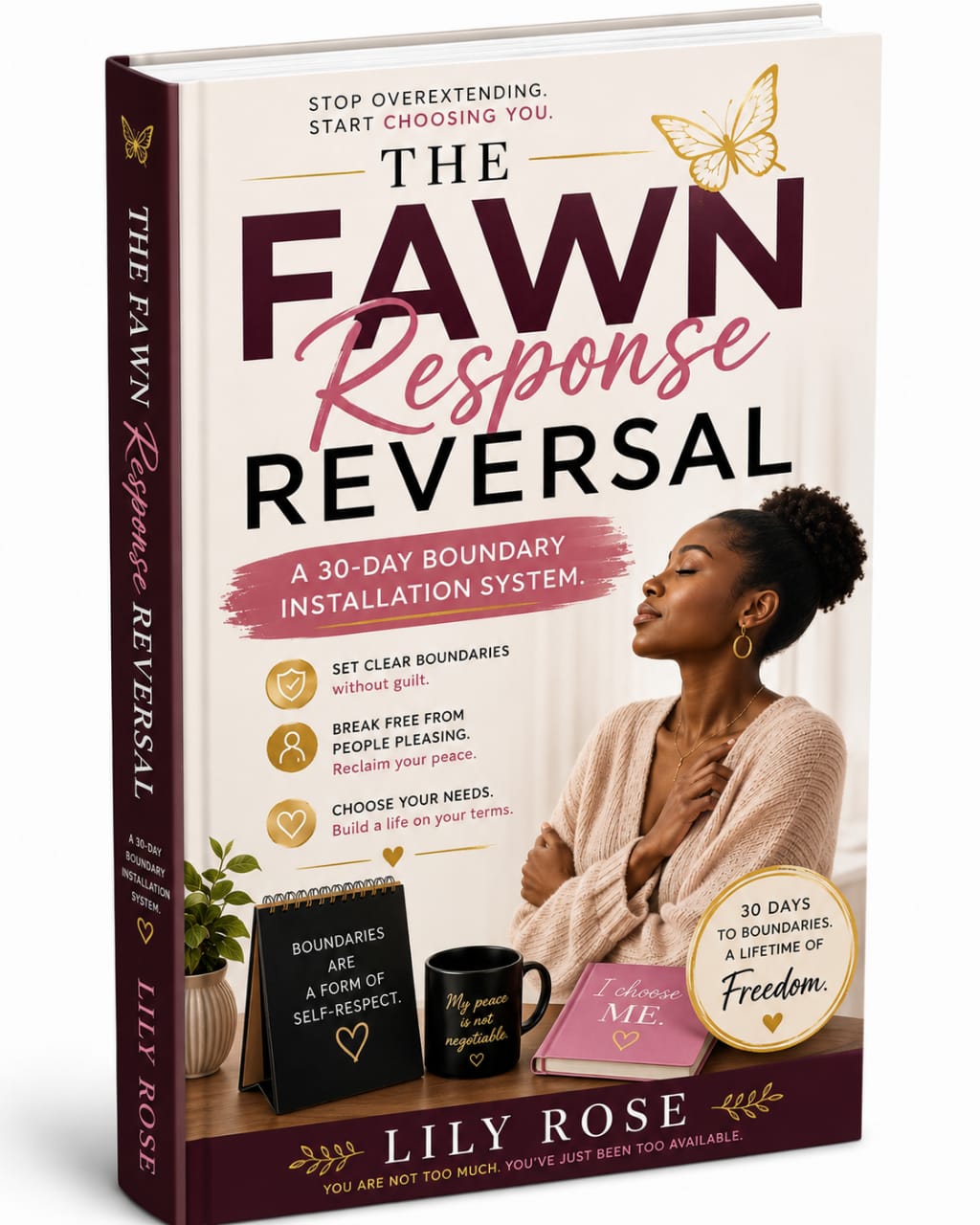
The yes comes out before you've decided to give it.
This guide is built around a simple, uncomfortable idea: chronic people-pleasing isn't a personality trait or a character flaw. It's a nervous-system pattern — the fawn response — that fires faster than conscious thought. Understanding that is the first step to interrupting it.
Why willpower hasn't worked
Journaling, affirmations, and "next time I'll say no" all operate on conscious thought. The fawn response lives in the nervous system — one level below where those tools can reach.
The four-second window
Most yeses are decided before you've had a chance to think. This guide teaches you to catch that window — the small gap where a real choice is still possible.
The cultural weight
For many women, the pressure to be endlessly available is reinforced by family, faith, and community. This guide addresses that layer directly, not as an afterthought.
Why boundaries collapse
Most boundary attempts fail because they start with the hardest relationship first. This system builds evidence gradually, starting with the lowest-stakes ones.
Seven chapters. One complete system.
Each chapter builds on the last — from understanding the pattern, to naming it, to installing a new one, day by day.
You're Not Too Nice. You're Terrified.
Where the pattern started, and why it was never a character flaw — it was survival intelligence with no off switch.
The Yes Autopilot
The neuroscience of the four-second window, and why every previous attempt to "just say no" was fighting the wrong battle.
Meet Your Fawn Response
The four fear triggers behind an automatic yes — abandonment, conflict, identity, and status — and which one runs your pattern.
The No Ladder
A five-rung script library, from strangers to family, so you always have the exact words for the moment in front of you.
The Daily 30
Your day-by-day plan — a 3-minute check-in, a 7-minute task, a 5-minute audit — building evidence one rung at a time.
When They Push Back
The five tactics people use to pressure a boundary back open, what each one is really saying, and how to stay standing.
The Woman on the Other Side
What changes in daily life once the system is installed — plus a maintenance ritual to keep it that way.
The No Ladder
You don't start with your hardest relationship. You start with the bar, and add weight slowly — five rungs, lowest stakes to highest.
Thirty days. Four phases.
Fifteen minutes a day — a morning check-in, a daily task, an evening audit.
Root Exposure
No behaviour change yet — just seeing the pattern clearly enough to work with it.
The First Nos
Real-world practice at Rungs 1 and 2, with strangers and acquaintances.
Hard Conversations
Moving up to friends, work, and the first family boundary.
The New Identity
Consolidating the evidence into a maintenance ritual that holds.
One bonus, made to be used alongside the book.
Not a filler add-on — something built to sit next to the 30-day system while you work through it.
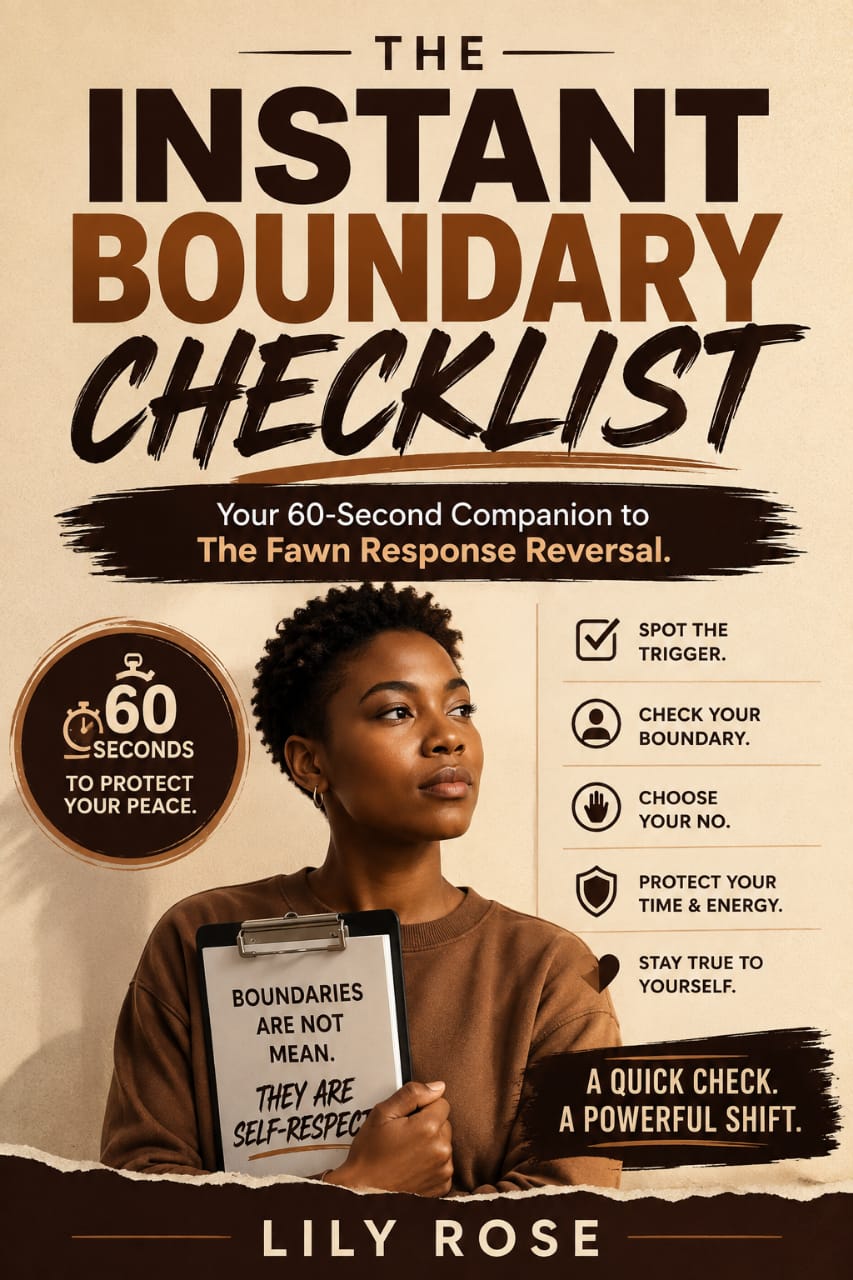
The Instant Boundary Checklist
Your 60-second companion to The Fawn Response Reversal — a quick five-step check (spot the trigger, check your boundary, choose your no, protect your time and energy, stay true to yourself) for the moment a request lands and you need to decide fast.
₦5,000₦2,000
Everything included, in one place.
-
✓
The Fawn Response Reversal (main guide) 7 chapters, the full No Ladder script library, the 30-day daily plan ₦12,600₦6,500
-
✓
Bonus: The Instant Boundary Checklist Your 60-second companion to the main guide ₦5,000₦2,000
Lily Rose

Lily Rose isn't a therapist or a clinician. By her own account, she's a woman who spent years saying yes from fear — until an ordinary afternoon sitting outside a supermarket in Benin made it impossible to keep calling it kindness. A phone call, a reflexive yes to a request she couldn't afford, and the sudden, uncomfortable realization that she hadn't actually chosen anything. She'd been executing a program.
That moment sent her looking for why the pattern kept winning — not through therapy language or borrowed Western frameworks, but through a structure built specifically for the pressures she recognized: family, church, culture, and the particular weight carried by women who were taught early that being needed was the safest way to be loved. The Fawn Response Reversal is the system she built for herself, then tested and refined by walking other women through it.
This guide is built from lived experience, not clinical training, and isn't a substitute for therapy. If you're navigating trauma or a mental health condition alongside these patterns, a licensed professional is worth having in your corner too.
This bio is drafted from the real personal story already in Chapter 1 of your guide. If any specific details here (location, timing, etc.) aren't accurate to your actual experience, edit freely before publishing.
Everything you need to start today.
Plus the Instant Boundary Checklist bonus below — ₦8,500 total.
Get instant accessBefore you start
How is the guide delivered?
As a downloadable PDF you can read on your phone, tablet, or computer. Confirm your actual delivery method here
Do I need to follow it in order?
Yes — the system is sequential by design. Week 1 builds the awareness that Week 2's practice depends on, and so on through Week 4. Skipping ahead is the most common way the ladder collapses under pressure.
What if my situation is mostly about family, not friends or strangers?
That's exactly why the guide starts at the bottom of the ladder rather than the top. Family boundaries, Rung 5, are addressed directly in Chapter 4's script library and again in Week 3 — but only after the earlier rungs have built the groundwork.
Is this guide specific to any particular cultural context?
Yes — the guide addresses the fawn response as a nervous-system pattern, and also directly addresses the cultural and religious reinforcement of people-pleasing that many African women, and the diaspora, navigate specifically.
What happens if someone pushes back hard on a boundary?
Chapter 6 is dedicated entirely to this — five common pushback tactics, what each one actually means, and a 90-second protocol for staying grounded in the moment.
Is there a refund policy?
Add your real refund/guarantee policy here, or remove this question if you don't offer one
You already know the pattern. Now install the change.
Thirty days, fifteen minutes a day, and a script for every relationship in your life.
Get the guide